Early Growth Modification: Your Child’s Path to Simple Braces in Kayamkulam
• 9 min read • By Dr Sajitha S
Introduction: The Proactive Path to a Perfect Smile
Imagine your child needing years of extensive, multi-phase orthodontic treatment, potentially including tooth extractions or even surgery. Many parents worry this level of complexity is an unavoidable consequence of genetics. We have good news: for most developing smiles, that simply isn’t true.
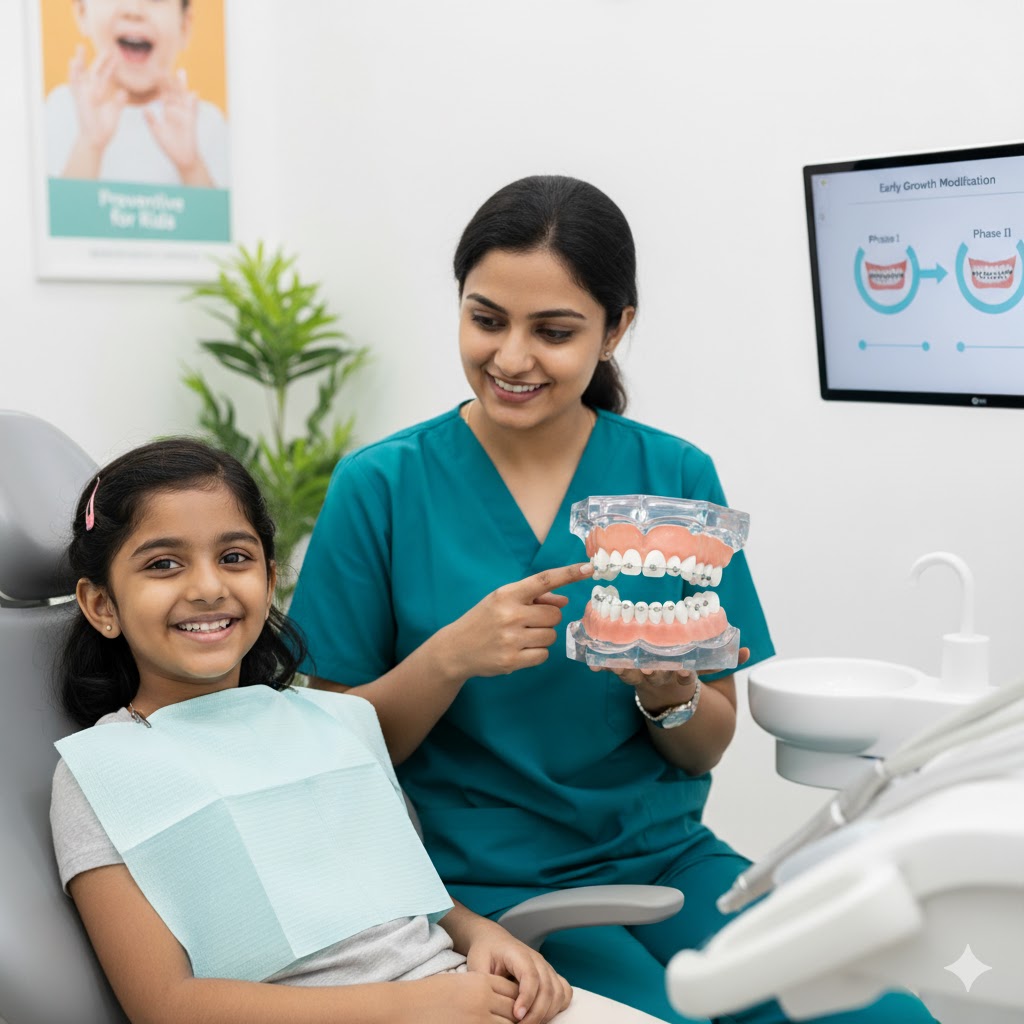
In the world of modern dentistry, we learned that when we treat an issue is often more important than the treatment itself. This is the cornerstone of early growth modification, a proactive approach that utilizes a child’s natural developmental window to guide the jaws and teeth into their correct positions. By implementing these simple, timely interventions, we can frequently help children avoid complex orthodontic treatment altogether.
If you are a parent searching for a trusted dentist near me in the Kayamkulam region, understanding this proactive approach is the single best step you can take for your child’s dental future. We are talking about dental detective work—learning to catch the malocclusion at the time of occurrence. This post will explore how interceptive orthodontics and preventive orthodontics can eliminate the need for complicated and invasive procedures, leading your child down the path to simple braces and a beautiful, confident smile.
Section 1: The Critical Window: Why Age Seven is the Magic Number
Dentists recommend the first orthodontic screening by age seven. Why this specific age? It’s simple: the first permanent molars and incisors have typically erupted, establishing the foundation of the bite. This allows a qualified professional to assess both the existing dental alignment and the underlying skeletal structure.
The Power of Growth Spurts
Children’s jaws and facial bones contain active growth centers (sutures) that are highly responsive to gentle, corrective forces. This period, often called early growth modification, is the “golden window.” We are not fighting against the body; we are working with its natural development.
We distinguish between two major orthodontic phases:
- Phase I (Interceptive): Typically between ages 6 and 10, using the mid-childhood growth spurt to guide the development of the jaws and dental arches.
- Phase II (Comprehensive): Typically during adolescence (12+), focusing on aligning the permanent teeth (traditional braces) after the jaw structure is ideally positioned.
The key advantage of early treatment is that we are modifying the foundation (jaw structure) itself, rather than simply moving teeth on a fixed, potentially misaligned foundation later. Waiting until age 12 or 13 means the opportunity to modify growth is largely lost, forcing us to manage the established problem through more drastic measures.
Section 2: Preventive Orthodontics: Stopping Problems Before They Start
Preventive orthodontics focuses on maintaining the ideal conditions necessary for healthy jaw and tooth development. These are often the simplest, lowest-cost interventions that provide the highest long-term returns.
Space Management: The Crucial Element
The primary teeth (baby teeth) are crucial space holders for the permanent teeth developing beneath them. If a primary tooth is lost prematurely—whether due to injury or extensive decay—its neighboring teeth immediately begin to drift, stealing the necessary space for the permanent successor.
The intervention here is the use of a simple space maintainer. Your dentist near me can place this small, fixed or removable device to ensure that the vital space remains open until the permanent tooth is ready to erupt. This is a classic example of low-cost, effective intervention preventing major crowding issues later.
Habit Correction: Remodeling the Bone
Chronic habits actively remodel bone structure in the wrong direction. Habitual thumb sucking, finger sucking, or persistent tongue thrusting, particularly past age four or five, can push the upper front teeth out, causing protrusion and an open bite.
Your Kayamkulam dental team can help with behavior modification techniques or specialized, gentle appliances (habit breakers) to stop these actions. By halting the habit early, the jaw often self-corrects, completely eliminating a future malocclusion.
Foundational Care: Teeth Cleaning in Kayamkulam
No orthodontic treatment is effective without a healthy mouth. Ensuring your child receives regular check-ups and thorough teeth cleaning in kayamakulam is vital. Healthy gums and teeth ensure the orthodontic environment is stable and ready for any intervention, maximizing success and minimizing complications.
Section 3: Interceptive Orthodontics: Catching Malocclusion at the Time of Occurrence
Interceptive orthodontics are targeted treatments (Phase I) specifically designed to correct developing bite problems (malocclusion) that cannot be fixed by simple habit cessation or space maintenance.
Scenario 1: Crossbites and Palatal Expansion
- The Problem: A common skeletal issue where the upper arch is too narrow, causing the upper teeth to bite inside the lower teeth. This forces the lower jaw to shift to the side when closing, leading to asymmetrical facial growth and potential jaw joint (TMJ) problems later.
- The Solution: Dentists use Palatal Expanders. This appliance gently widens the upper jaw suture while it is still soft and pliable. This simple treatment typically lasts only 6-9 months.
- Direct Benefit: We correct the crossbite and ensure symmetric facial growth. Crucially, expansion often creates several millimeters of space, completely solving a major crowding problem and eliminating the need for permanent tooth extractions later.
Scenario 2: Severe Overbites (Skeletal Class II)
- The Problem: The lower jaw is significantly behind the upper jaw. This severe discrepancy leads to significant protrusion of the upper teeth (an overjet), dramatically increasing the risk of dental trauma (breaking or chipping the teeth).
- The Solution: Functional Appliances (like the Herbst or Bionator). These devices encourage the lower jaw to grow forward into the correct position.
- Direct Benefit: This appliance is worn during the growth spurt, maximizing its skeletal correction. We change the underlying jaw relationship, achieving a result that would only be possible with invasive jaw surgery once growth is complete.
Scenario 3: Eliminating Future Crowding
- The Problem: The child’s arch simply lacks the necessary perimeter for all 28 permanent teeth.
- The Solution: Serial Extraction and Partial Braces. Serial extraction is the managed, strategic removal of specific primary teeth to guide the eruption of the permanent teeth into better positions. In some cases, a limited number of braces are necessary to tip a few permanent teeth into alignment to finalize the arch form.
- Direct Benefit: These steps make the eventual adolescent treatment (Phase II) much shorter, simpler, and less comprehensive, often reducing the treatment time by a year or more.
Section 4: The High Cost of Delay: Why Complex Orthodontic Treatment Becomes Necessary
Once jaw growth is complete (usually in the late teens), the opportunity for skeletal modification is gone. If a severe skeletal problem (like a massive overbite or underbite) was not intercepted, the issue is locked in. This is when orthodontics transitions from modification to compensation, and complexity skyrockets.
The Definition of Complex Treatment
- Mandatory Extractions: The most common consequence of delayed treatment. When skeletal expansion is no longer possible, the only way to create space for crowded teeth is often to pull healthy permanent teeth (premolars).
- Orthognathic Surgery (Jaw Surgery): For severe skeletal discrepancies, moving teeth alone cannot camouflage the underlying jaw problem. Surgery is the only way to align the jaws properly. This is highly invasive, requires hospitalization, and involves a lengthy recovery.
- Extended Treatment Time: Full, comprehensive braces (Phase II) take longer when the skeletal foundation is poor. Treatment for a 14-year-old with a significant problem can easily last 30-36 months, compared to a Phase I intervention of 9-12 months followed by simpler Phase II treatment.
Financial and Emotional Impact
Contrast the experience of wearing a simple, removable functional appliance for less than a year as a child with the difficulty of two years of full fixed braces plus potential surgery as a teen or adult. Interceptive treatment is generally more cost-effective and psychologically easier on the child than multi-year complex braces or surgery later. By choosing early growth modification, you choose simplicity, efficiency, and confidence.
Section 5: Choosing the Best Dental Clinic Kayamkulam for Your Child’s Future
When you choose a dental provider for your child, you choose their dental future. Finding the right practice focused on prevention is key.
Expertise in Interception
When you search for the best dental clinic Kayamakulam, parents must specifically inquire about their experience with Phase I and interceptive orthodontics. A clinic that prioritizes early detection and treatment shows they are committed to minimizing your child’s need for future invasive care.
The Comprehensive Care Model
A great clinic integrates orthodontics seamlessly with general dentistry. They should not only offer growth modification but also be your reliable provider for routine check-ups and excellent teeth cleaning in kayamakulam. This comprehensive approach ensures that the environment for orthodontic treatment is always stable and healthy.
What to Ask Your Kayamkulam Dentist:
Before committing to a practice, ask specific questions:
- “Do you follow the age-seven evaluation guideline?”
- “What is your protocol for managing space when a baby tooth is lost early?”
- “Can you show me examples of skeletal corrections achieved through early growth modification?”
The team should clearly explain why treatment is necessary now and how it will prevent the necessity of complex treatment later. They should be transparent about the estimated length and cost of both Phase I and the predicted Phase II treatment.
Your Actionable Next Step
Do not wait for a small problem to become severe. Be proactive. Schedule that age-seven evaluation. Even if the result is “wait and monitor,” you gain invaluable peace of mind, an established timeline, and a documented baseline for tracking growth. This simple appointment with a trusted dentist near me is the best investment you can make in your child’s long-term oral health.
Conclusion: Invest in Simplicity, Reap the Confidence
The evidence is clear: early growth modification can avoid complex orthodontic treatment. By partnering with a trusted dental professional and embracing the power of interceptive orthodontics, you give your child the greatest chance for a naturally guided, healthy smile. Do not let minor issues become major hurdles. For parents in the region, scheduling that early screening at the best dental clinic kayamakulam is the simplest, most powerful decision you can make today. Choose the proactive path to a confident future and a lifetime of straight, simple smiles.
Leave a Reply